A SIX-PART INTERACTIVE BIBLICAL JOURNEY
The High Holy Days Journey
Follow the story from the sound of the shofar to the question of forgiveness. Each email opens the next chapter; your progress stays with this browser.
CHAPTER 01
START HERE
The Christian's Guide to the Jewish High Holy DaysBEGIN WITH THE FREE GUIDE
START HERE
The Christian's Guide to the Jewish High Holy Days JOIN THE FREE JOURNEYHOW DOES A SINFUL HUMAN BEING RECEIVE FORGIVENESS FROM A HOLY GOD?
THE SIMPLE VERSION
Three stages. One connected season.
Rosh Hashanah, the Days of Awe, and Yom Kippur form one connected season. This first chapter gives you the map before the journey slows down and goes deeper.
2026 AT A GLANCE
Keep the calendar simple.
Rosh Hashanah beginsSEP 12-13Rosh HashanahSEP 14-19Days of Awe continueSEP 20SUNDOWN
Yom Kippur beginsSEP 21NIGHTFALL
Yom Kippur ends
WORDS YOU'LL HEAR
No background required.
A ram's horn used as a ritual trumpet. Its sound is central to Rosh Hashanah.
Repentance with the idea of turning or returning to God.
The Day of Atonement and culmination of the High Holy Days.
The appointed priest who held the unique biblical Yom Kippur role.
The Jerusalem sanctuary at the center of the biblical sacrificial system.
In the biblical sacrificial context, the God-prescribed means of dealing with sin and restoring right relationship.
5 READINGS TO START WITH
Follow the roles before you chase every detail.
- Leviticus 23:23-25
- Numbers 29:1-6
- Joel 2:12-17
- Leviticus 16
- Hebrews 9:6-14
CHAPTER 02
THE SHOFAR
Rosh Hashanah & the ShofarIF ALL YOU KNOW IS "JEWISH NEW YEAR"
The sound is the doorway.
Rosh Hashanah is commonly called the Jewish New Year, but the biblical passages emphasize a sacred day marked by sounding or blasts. The shofar becomes the doorway into the season.
HEAR THE SHOFAR
Learn the four sounds.
Sound never autoplays. Individual clips appear here when uploaded in WordPress.
THE AKEDAH - GENESIS 22
The ram's horn carries a story.
Abraham is stopped from sacrificing Isaac, and a ram caught in the thicket is offered instead. Randy emphasizes the substitute as a thread that prepares the reader for the campaign's later discussion of sacrifice and atonement.
CHAPTER 03
THE TEN DAYS
The Days of AweWHAT ARE THE DAYS OF AWE?
Rosh Hashanah wakes you up. The ten days ask you to examine where you are.
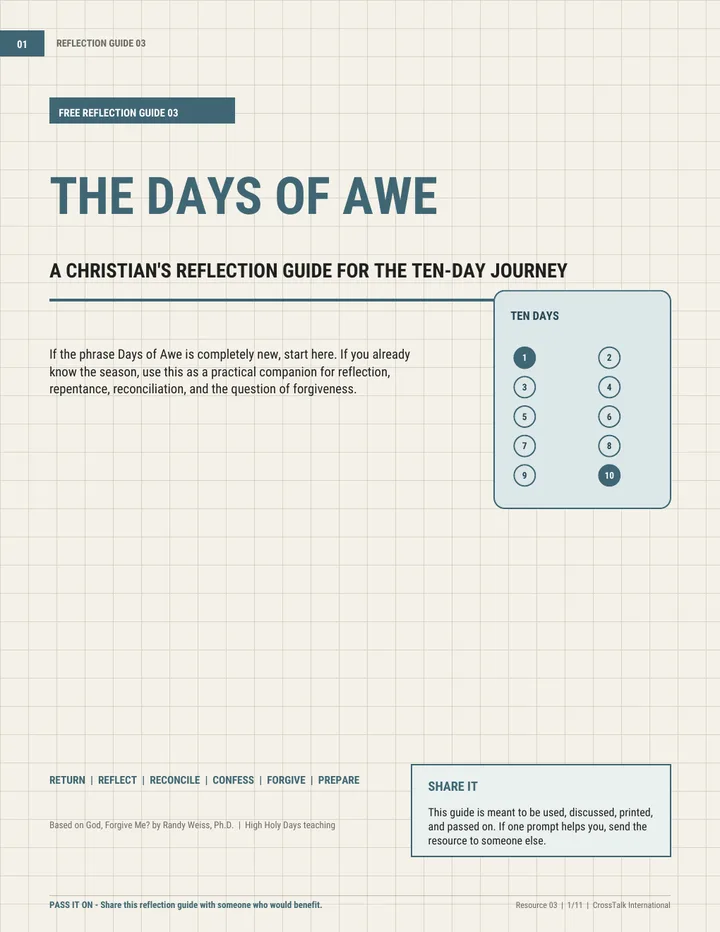
The Days of Awe are the ten-day journey from Rosh Hashanah toward Yom Kippur in Jewish tradition - a season associated with repentance, self-examination, reconciliation, and seeking forgiveness.
PAUSE FOR A MOMENT
Private reflection. Nothing you type or think here is stored.
Is there something you need to admit?
Is there someone you have wronged?
Is there someone you need to forgive?
What would returning to God actually look like?
A 10-DAY REFLECTION PATH
Tap a day. Keep the question with you.
WAKE UP
Where have I been spiritually asleep or on autopilot?
CHAPTER 04
THE DAY OF ATONEMENT
Yom Kippur & Leviticus 16LEVITICUS 16 - PIECE BY PIECE
Do not begin with a wall of ritual detail. Follow the system.
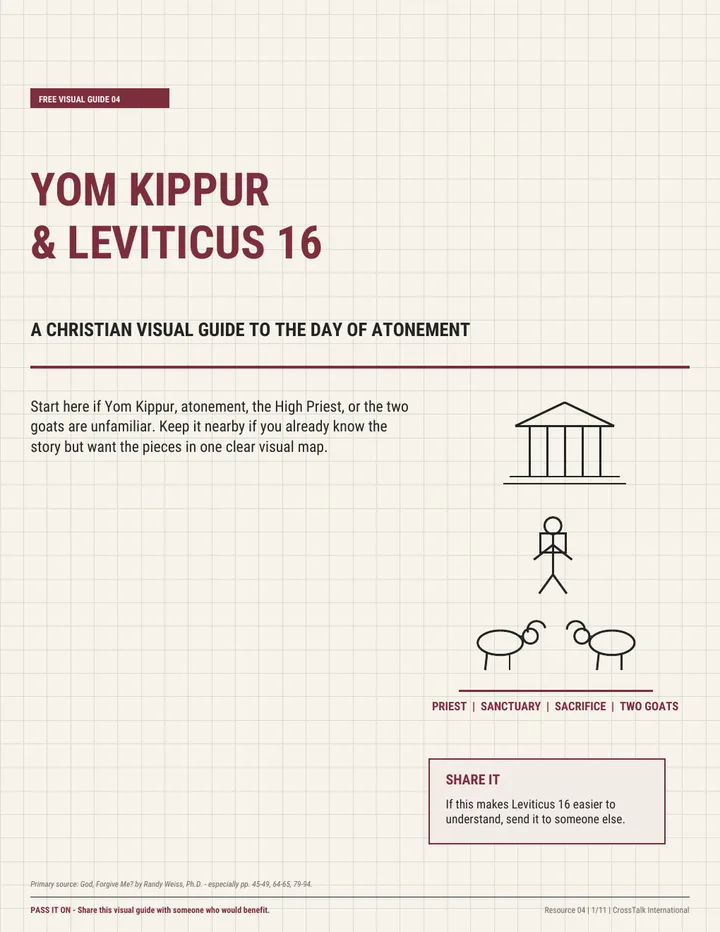
Yom Kippur brings the High Holy Days to the question of atonement. In the biblical service, the High Priest, sanctuary, sacrifice, blood, confession, and two goats belong to one ordered system.
The appointed representative enters the sacred service on behalf of Israel.
The service belongs to an appointed holy place.
Prescribed offerings are part of the biblical system.
Leviticus connects life, blood, altar, and atonement.
The ritual is directed toward dealing with guilt and restoring relationship.
BEFORE THE TWO GOATS
Why are goats part of Yom Kippur at all?
Leviticus 16 describes two goats as part of one Day of Atonement ritual for the people of Israel. The High Priest assigns the goats two different roles. One becomes a sin offering — a prescribed sacrifice offered because of sin. The other remains alive while the people's sins are confessed over it, and it is then sent away into the wilderness.
They are not two unrelated animals in the story. Together they are part of the biblical picture of atonement: sin is dealt with through the prescribed sacrifice, and confessed sin is pictured as being carried away.
TWO GOATS. ONE ATONEMENT RITUAL.
Two different roles.
Leviticus describes the second goat being released into the wilderness. Randy separately notes later Jewish tradition about a precipice; that later tradition should not be confused with the wording of Leviticus itself.
BIBLICAL TEMPLE SERVICE
Priest + sanctuary + sacrifice + blood + confession + two goats.
MODERN JEWISH OBSERVANCE
Fasting + prayer + synagogue worship + repentance + seeking forgiveness.
These are connected traditions, but they are not identical. Randy's book asks readers to keep the biblical Temple service distinct from modern observance before evaluating his Christian argument.
CHAPTER 05
AFTER THE TEMPLE
What Happened After 70 CE?THE TURNING POINT
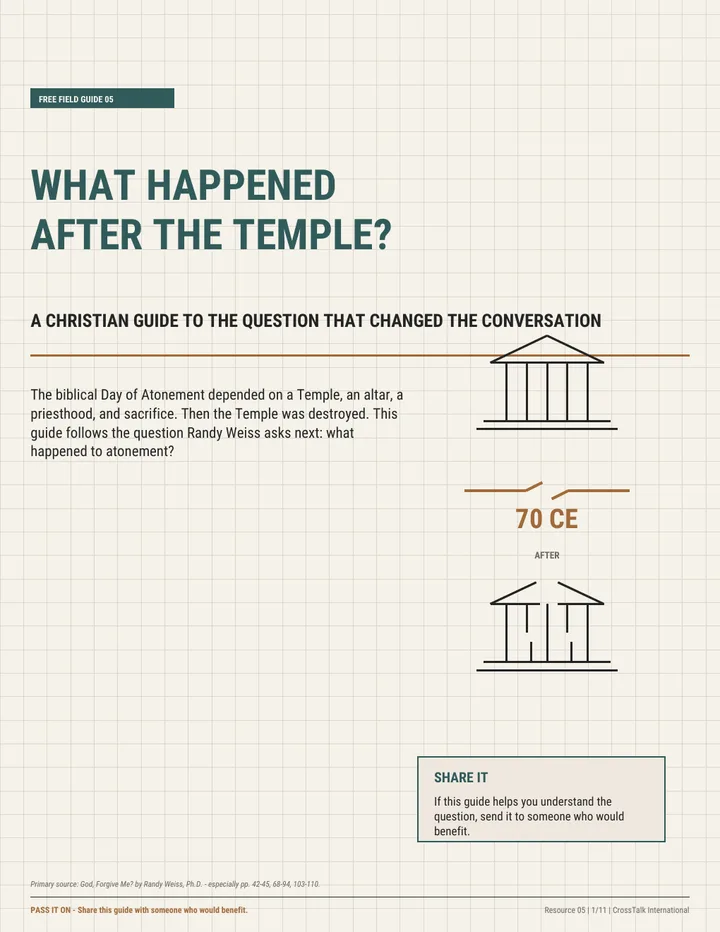
The Temple was not a side note to the system Randy is tracing.
Randy treats the destruction of the Second Temple as a turning point because the Jerusalem altar, Temple priesthood, and prescribed sacrificial system could no longer function as before.
POST-TEMPLE PRACTICE
What Jewish traditions practice - and how Randy evaluates them - are two different questions.
The descriptions below follow Randy Weiss's presentation in God, Forgive Me?. They are not a complete neutral survey of every Jewish movement or scholarly view.
Randy discusses the growing role of prayer in post-Temple Jewish life.
Repentance - turning or returning to God - remains central to the High Holy Days.
Yom Kippur fasting becomes a major expression of afflicting the soul and seeking forgiveness.
Randy affirms compassion and mitzvot while arguing that good deeds are not identical to atonement.
Randy describes the symbolic casting-away custom while distinguishing it from biblical atonement.
Randy discusses this later ritual in connection with substitution and expiation, not as the Temple sacrifice itself.
A KEY TEXT - HOSEA 14
"Take with you words" becomes part of the conversation.
Randy notes that Hosea calls Israel to return, bring words, and ask for forgiveness. He affirms prayer and repentance while asking a narrower question: does bringing words replace the entire sacrificial structure prescribed in the Torah, or call people to return within the larger biblical story?
GOD, FORGIVE ME?
CHAPTER 06
GOD, FORGIVE ME?
Scripture & DiscussionGOD, FORGIVE ME?
THE WHOLE JOURNEY
Wake up. Return. Atonement. Temple. 70 CE. The question.
The final chapter brings the whole journey together: sin, guilt, sacrifice, atonement, the Temple, forgiveness, and Randy Weiss's explicitly Christian conclusion.
RANDY'S CHRISTIAN CONCLUSION
Randy's final answer is Jesus.
At the end of God, Forgive Me?, Randy states his explicitly Christian conclusion: Jesus is the perfect, unblemished, substitutionary sacrifice. This is Randy's theological argument, not a neutral description of what every Jewish or Christian tradition believes.
Randy repeatedly asks readers to investigate the passages themselves rather than accept his conclusion merely because he wrote it.
READ IT YOURSELF
Follow the Scripture progression.
ram / substitute / provision
offering / laying on hands / atonement
High Priest / two goats / Day of Atonement
life / blood / altar / atonement
suffering / sin-bearing / offering
Randy concludes that Jesus is the perfect, unblemished, substitutionary sacrifice.
MAKE IT A REAL CONVERSATION
Use this alone, with a friend, or with a group.
KEEP THE COMPLETE COLLECTION
Download all six printable companion resources together for offline study, printing, or a group.
YOU MADE IT THROUGH ALL SIX RESOURCES
DON'T LET THE JOURNEY END HERE
The High Holy Days journey can become the beginning of a longer relationship with the biblical questions, the book, and CrossTalk.GO DEEPER WITH GOD, FORGIVE ME?
The six free resources introduced the major questions. Randy Weiss’s full book contains the deeper teaching, research, stories, sources, context, and complete argument.
GET THE BOOKSTAY CONNECTED WITH CROSSTALK
CrossTalk continues producing biblical teaching, television programs, Jewish-roots teaching, books, videos and ministry resources.
You already joined with your email. This simply marks that you want to keep engaging with CrossTalk.CONTINUE WATCHING CROSSTALK
Choose one place to continue. We keep this intentionally simple.